Ethereum


Gateway to the decentralized future

About


Ethereum

is a decentralized blockchain platform for building decentralized applications(DApps) , Decentralized technology uses peer-to-peer computer networks and are not subject to the whims of a central authority such as a government or server administrator, which can help to achieve better decision making for public good.

Ethereum is one of the most popular cryptocurrencies in the world only second after Bitcoin, according to Coinmarketcap, Ethereum has made itself a name to reckon with in the crypto world.

Ethereum is a decentralized, self-contained economy for transactional computation and related data.

@djrtwo on Medium /ethereum-in-a-sentence

Ethereum is a blockchain based network which can be used to create decentralized apps. The Ethereum token is Ether - the cryptocoin which fuels the Ethereum network. Ethereum’s USP lies in the fact that is not used only for digital currency transactions, it can also be used to create massively decentralised contracts and applications.

Blockchain

means that the currency is built and secured by adding and verifying blocks of transactions(Mining) to blocks made previously, thus forming a "chain". Blocks added to the chain become harder and harder to crack over time, as they are verified by more nodes in the blockchain peer-to-peer network.
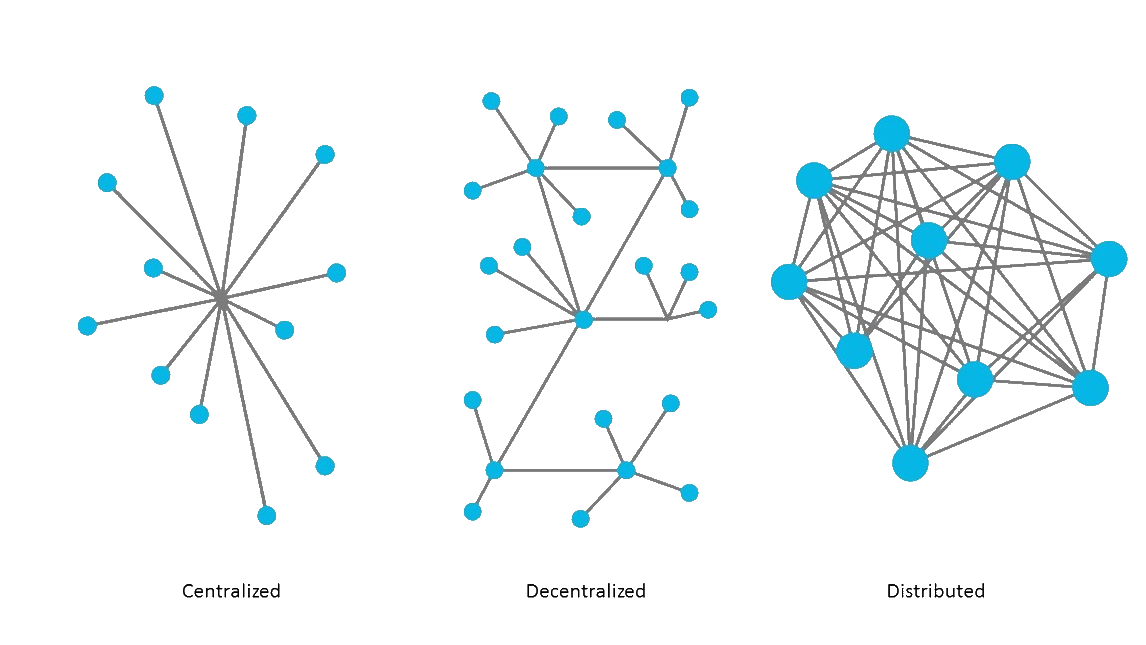
Blockchain infographic

Blockchain technology has been referred to as the Web 3.0. The Web 3.0 is starting to be defined as the movement away from centralization of computation power in servers which provide services to clients (known as the client-server network model) to peer-to-peer networks and blockchains, and from centralisation of authority and sovereignty from nation-states and corporations to the networked individual.
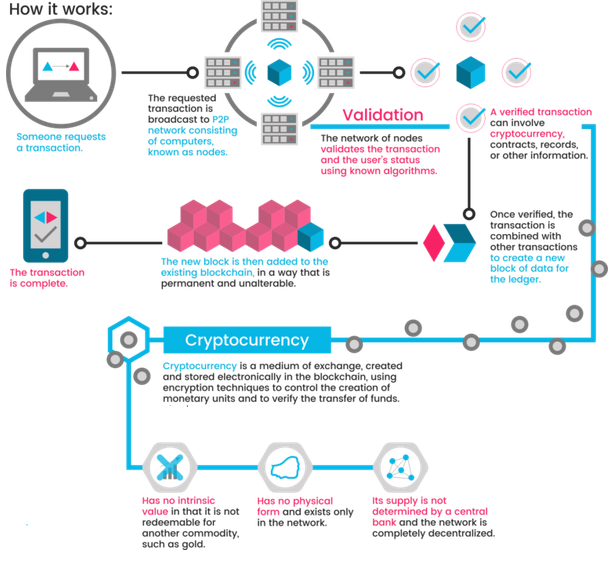
How It Works


ethereum infographic

Ethereum Mining

is a process of solving complex mathematical problems . Miners are essentially the cornerstone of any cryptocurrency network as they spend their time and computing power to solve those math problems, providing a so-called ‘proof of work’ for the network, which verifies Ether transactions. Besides that, miners are responsible for creating new Ether tokens through this process, as they receive rewards in Ether for successfully completing a proof of work task.

Mining serves several purposes

  • To verify the legitimacy of a transaction, or avoiding the so-called double-spending
  • To create new digital currencies by rewarding miners for performing the previous task
When you want to send a transaction this is what happens
  • Transactions are bundled together into what we call a block
  • Miners verify that transactions within each block are legitimate
  • To do so, miners should solve a mathematical puzzle known as proof-of-work problem
  • A reward is given to the first miner who solves each blocks problem
  • Verified transactions are stored in the public blockchain

Smart Contracts


Smart Contracts

are self-executing contracts with the terms of the agreement between buyer and seller being directly written into lines of code. The code and the agreements contained therein exist across a distributed, decentralized blockchain network. Smart contracts permit trusted transactions and agreements to be carried out among disparate, anonymous parties without the need for a central authority, legal system, or external enforcement mechanism. They render transactions traceable, transparent, and irreversible,

Use Cases

Elections

Voting results will be put in the Blockchain and distributed among the nodes of the network. All the data is encrypted and anonymous. This method eliminates any possibility of manipulation with the ballot.

Logistics

The supply chain is generally long and includes a lot of links. Each link has to get a confirmation from the previous one, to hold up its end of the contract and send the information further. It takes a lot of time and is unproductive, while with a smart contract each participant can see the progress and do the work in time.

Smart contracts ensure transparency in the contract terms, fraud protection. It can also provide shipments tracking with the integration of the Internet of Things. There are some other possible applications, i.e. in management, bank system, insurance, estate, IoT, and others.

About DApps


Decentralized applications(DApps)

A decentralized application (Dapp, dApp or DApp) is an application that is run by many users on a decentralized network with trustless protocols. They are designed to avoid any single point of failure. They typically have tokens to reward users for providing computing power.

The definition of a decentralized application is still in development and under debate. The term traces its origins to Decentralized Application Corporation and decentralized autonomous organization(DAO).

Typical definitions include the following attributes

  • The code is open-source and be autonomously managed
  • Records and data are stored using blockchain, providing trustless interaction and avoiding any single point of failure
  • Use cryptographic tokens reward users providing computing power
  • Tokens generated through a cryptographic algorithm

Decentralized applications run on top of other cryptographic systems such as Ethereum. Due to blockchain's ubiquitous nature, the high transaction volume of popular DApps can clog the network which leads to slower transaction times and inflated fees; in December of 2017, the popular game CryptoKitties slowed the Ethereum network and exposed the vulnerability of public blockchains to traffic slowdowns, to see all current Dapps and their rankings State of the DApps has a list of over 1800 DApps.

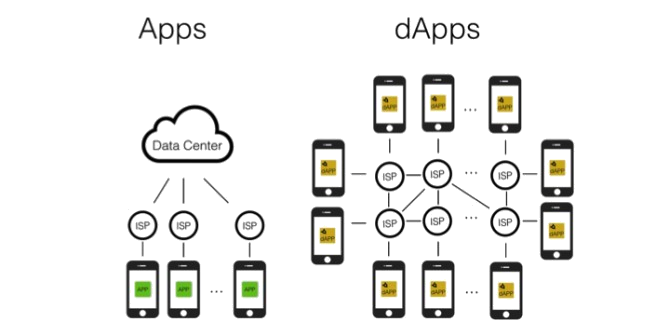
Dapps Image

Advantages

Higher level of security

The nature of Dapps provides for a higher level of overall security. Since the information is stored on a distributed ledger, a potential threat would have to go through the burden of hacking all of the connected nodes. This addresses popular attacks such as distributed denial of service (DDoS) . The nature of decentralization itself bars collusion and infiltration, making Dapps a whole lot harder to hack.

Enhanced transparency

Since Dapps run on blockchain, transactions that take place in it are easily verifiable. Everyone can access the record and check the status of current and previous transactions. This transparency also allows for precise verification of all the executed amendments to the code.

Resources